“Whoever acknowledges me before others, I will also acknowledge before my Father in heaven.” (Matthew 10:32)
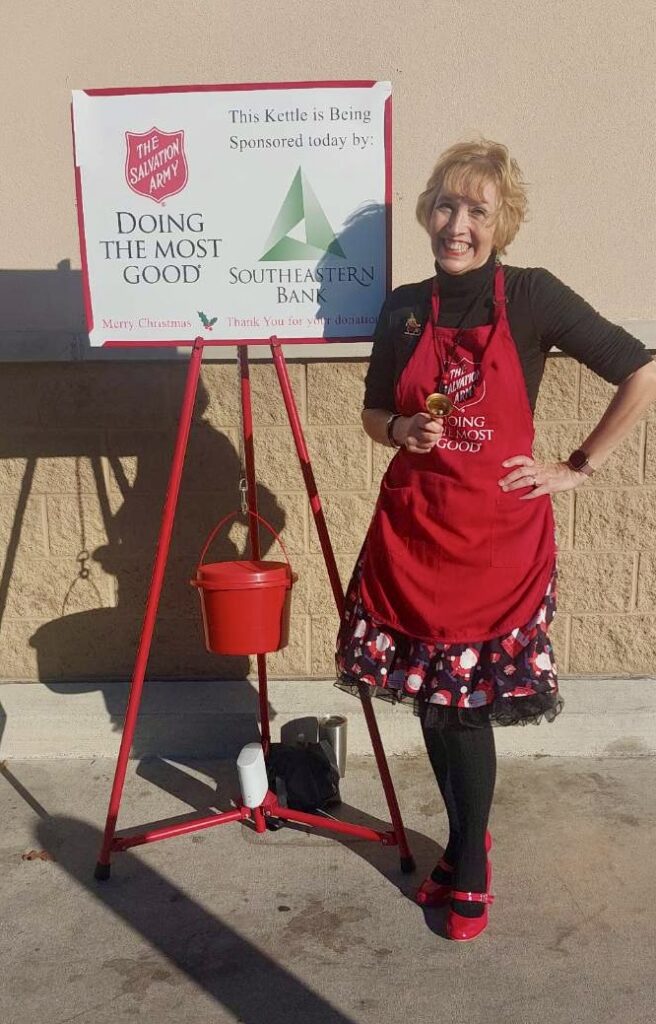
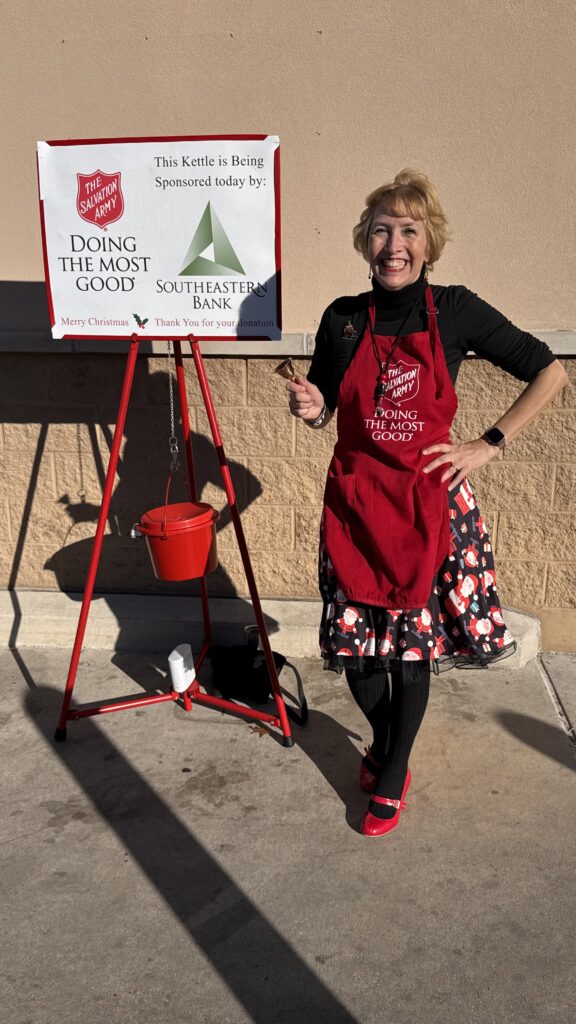
Day 1 of my bell ringing mission.
Before Christmas, I was privileged to spend four days smiling, dancing, greeting, and loving my community by ringing a bell outside my local Sam’s Club to collect money for my local Salvation Army. Notice I didn’t say that I was a bellringer. I was more than that. I was a giver and receiver of love – God’s love.
While I played music and rang a bell for hours each day, I also simultaneously offered blessings to everyone who walked past me. I never asked anyone for money. I just gave love – with my energy, smiles, and joy. The donations that came in, simply because people knew my cause was worthy and recognized the Red Kettle, blew me away – every single day. In fact, my kettle was so full at the end of my first day that the local coordinator provided me with two kettles each day thereafter.
Every day, someone touched my heart and soul. There was the man who, while riding by on his scooter, stopped to tell me he was in constant pain but still wanted to give to others. After telling him that I’d pray for him, he thanked me. “Sometimes, God uses pain to get our attention,” I said. He said he knew that, confirming he gave our Savior thanks every day for the ability to keep moving.
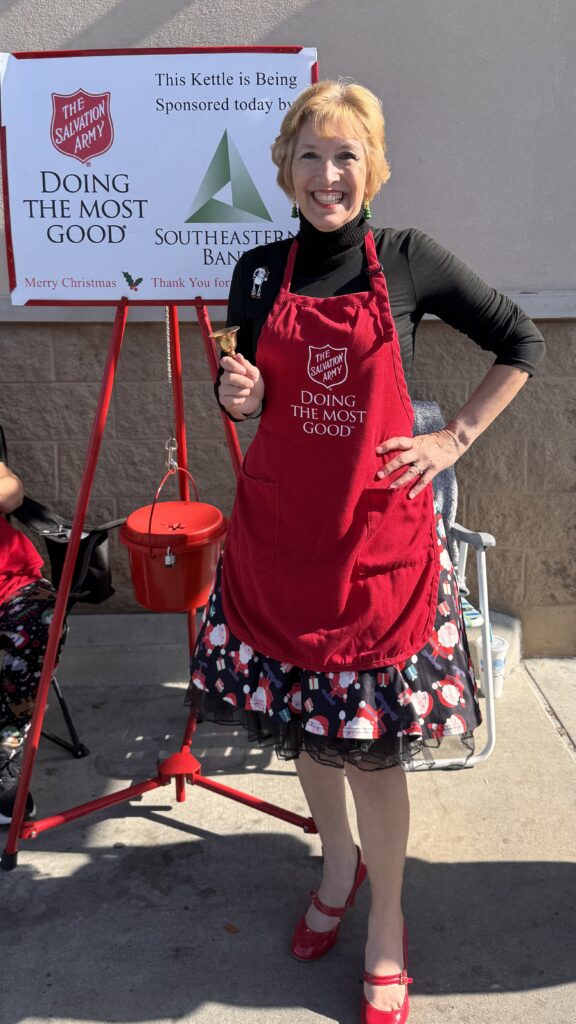
My Salvation Army Red Kettle was full to overflowing on the evening of my first dayof volunteer service.
There was the woman who told me it was her 65th birthday as she placed money in the kettle for others on her special day. I asked her if I could sing her the unique song my family has been repeating on birthdays since I was four years old. She agreed, so I showered her with “A happy birthday to you. A happy birthday to you. Every day of the year, may you find Jesus near. A happy birthday to you. A happy birthday to you. May this be your most blessed year!” When I was done, I hugged her and told her she was a blessing. She responded by saying that my simple song “made her day,” while I assured her that she had made mine!
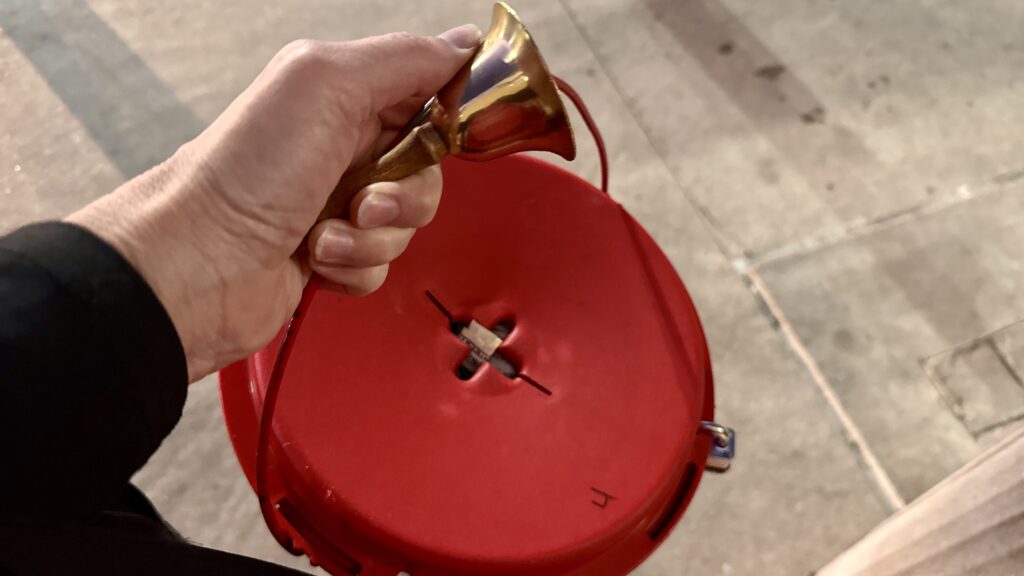
Day 2 of bell ringing.
There was also the pastor I didn’t know was a pastor, who went to his car, came back with a church newsletter, and handed it to me, saying, “You blessed me, now I want to bless you.” The newsletter featured a story he’d written, years before, talking about a classic car his father had helped him buy as a young man, and how much it meant to him. It seems that his father never expressed emotion, so he learned to withhold his feelings in the same way. When his father gave him what he perceived as an ugly, distasteful car ornament to add to the car, he withheld doing so for years, thinking he didn’t want to demean the car’s value by adding it.
Privately, he hadn’t thought about this ornament for decades, choosing to hide it just as he’d hidden his emotions. It was only when deciding to share the story in a sermon analogy that he faced the raw emotion of how we often hide our faith in Christ, never wanting to offend or demean others with His blood and sacrifice. As it turns out, the day he shared this story, his parents came to hear him preach – nearly causing him to rethink what he would openly disclose to both his congregation and father.
Day 3.
While urging his congregants never to be afraid of public perception, he looked over at his dad, who was wiping tears from his eyes. At that moment, the pastor left his pulpit, walked directly to his father, pulled him out of the pews, and told him he loved him. As the congregation cheered, he reminded everyone never to be afraid to show God’s love.
And so, I won’t. Whether it’s in front of Sam’s Club as I told every passerby, “God bless you” and “Merry Christmas” while playing traditional and contemporary carols, proclaiming the joy of Jesus, or by standing unafraid to tell others in my workplace how the light they see is Christ in me, we all must stand unafraid to talk to others about our Savior.
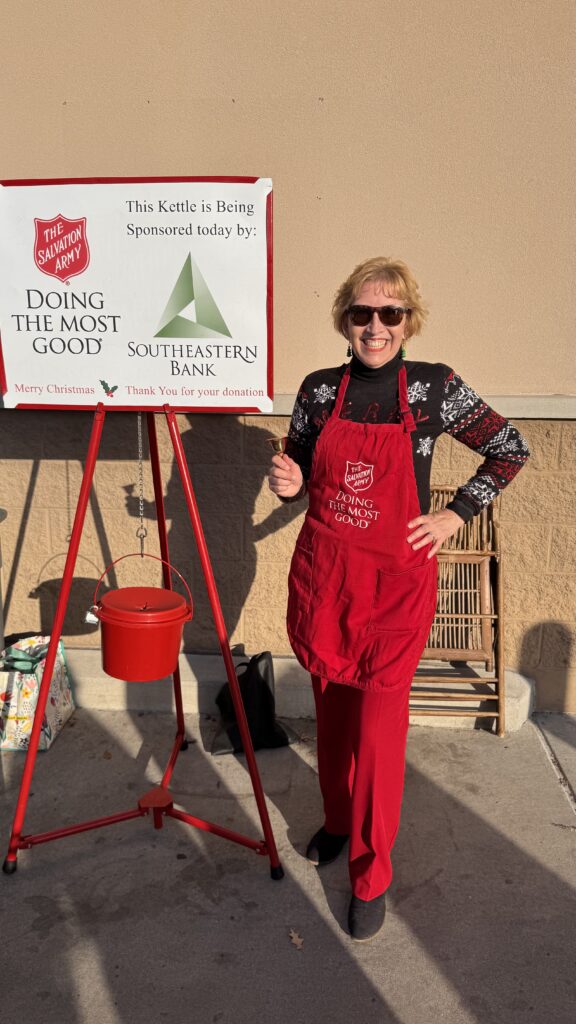
Day 4.Bell ringing on Christmas Eve.
Matthew 10:8 reminds us, “Freely you have received; freely give.” More important than filling a Red Kettle, may we generously bestow the love that Christ so sacrificially gave to us. If He could hang on a cross – stripped, broken, and bleeding to show His compassion for us – how can we give anything less to a world that so desperately needs Him?
We are the only gospel that many people will ever see – the only church they may ever know. We are Christ’s church, and everything we do should glorify our Savior and proclaim His love. This year, I am praying that God gives me more boldness, more faith, more passion for His faithfulness. I would be nothing without Christ. May I never be afraid to say so. May we all do the same.
Amplifying St. Francis – Italian Honeymoon, Part 4
And what does the Lord require of you? To act justly and to love mercy and to walk humbly with your God. (Micah 6:8)
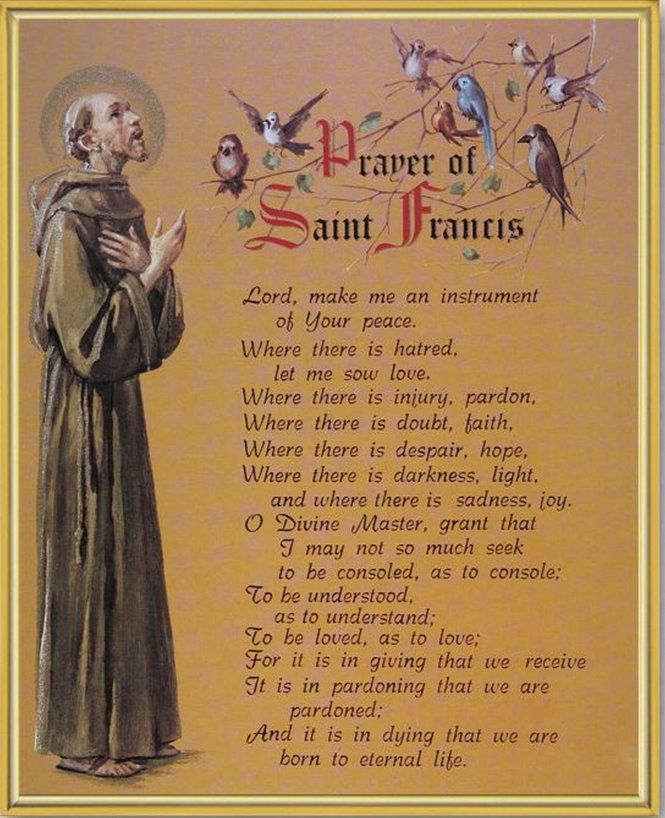
For decades, I’ve always felt a kindred unity with St. Francis, the patron saint of Italy, nature, and animals. While my initial fondness for St. Francis began after hearing the simple prayer attributed to him, I’ll admit that learning his Feast Day or remembrance would take place on my birthday – October 4th – further unified our kinship. The final linchpin came when I discovered that many churches celebrate the Feast Day of St. Francis with a service to bless animals. Then, I wholeheartedly embraced everything he stood for: evangelism, humility, love, service, and the unadulterated appreciation for all God’s creatures.
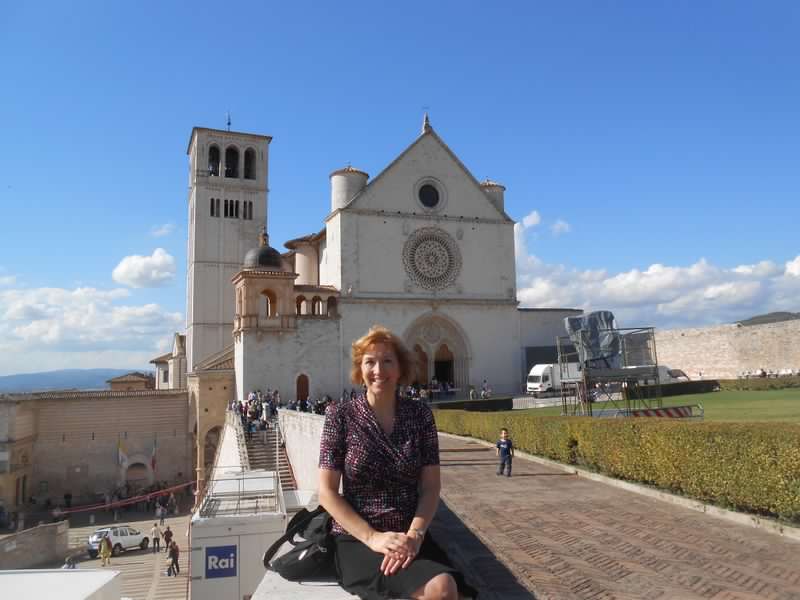
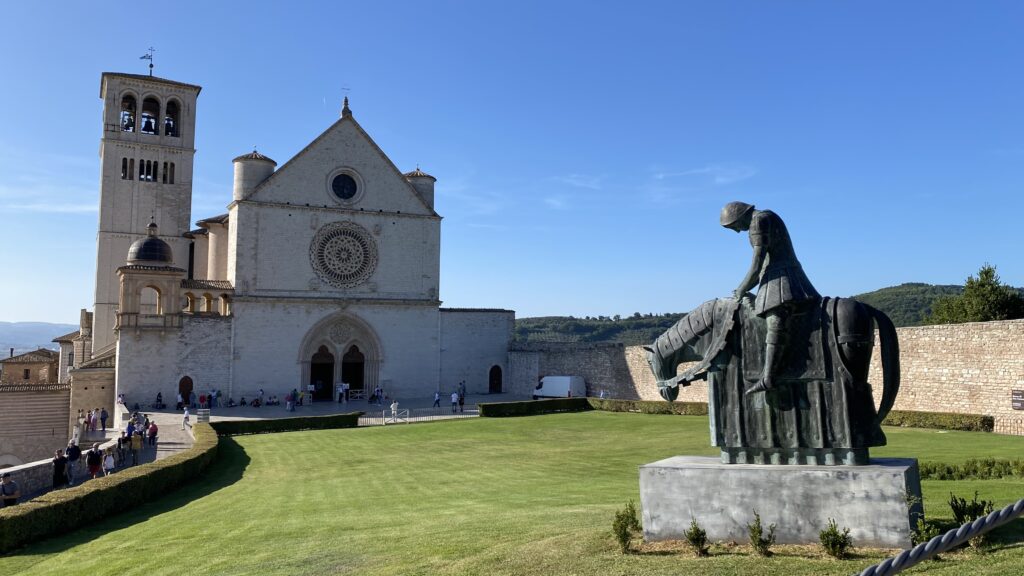
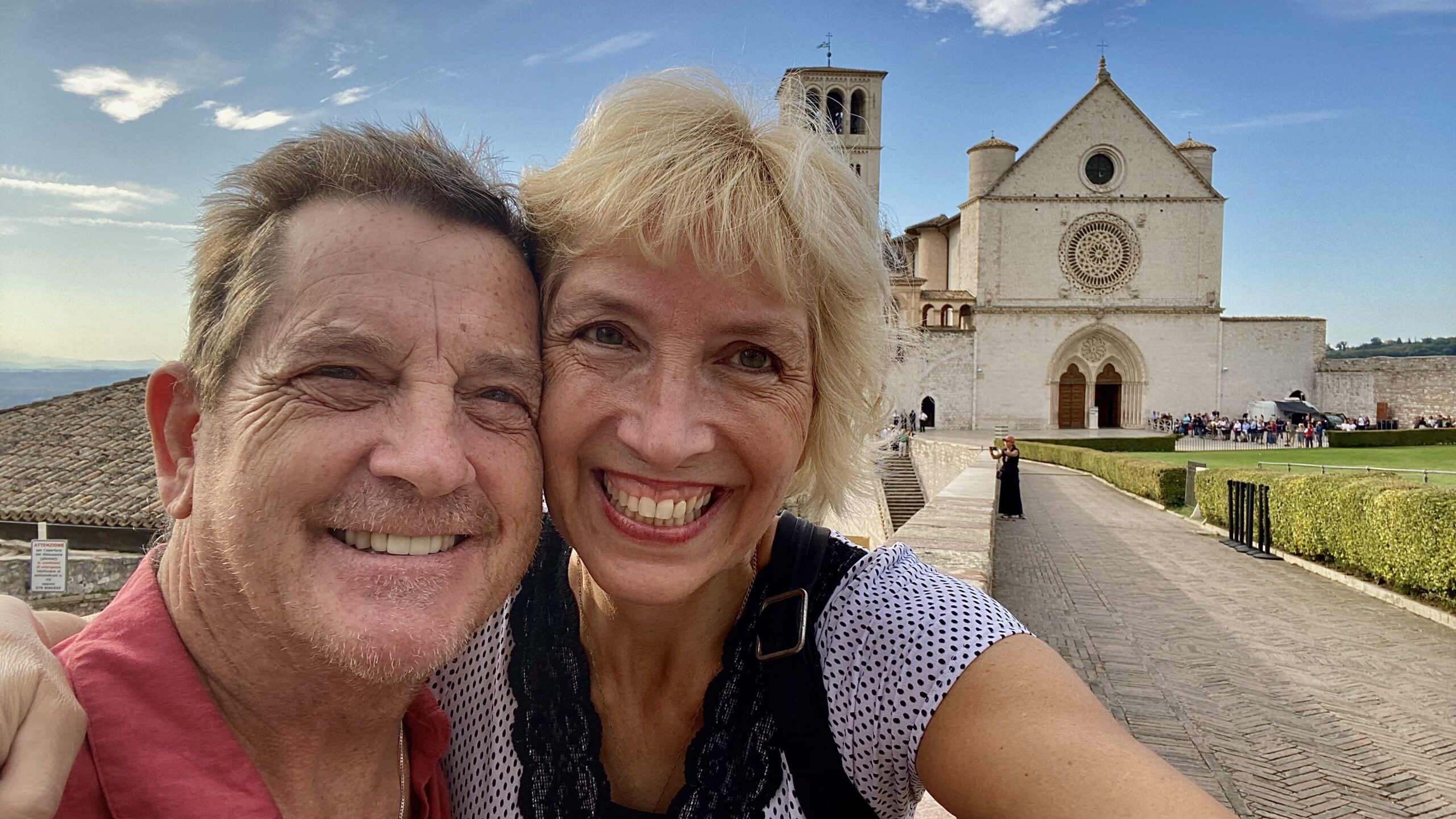
Me outside the Basilica of San Francesco, Oct. 2015.
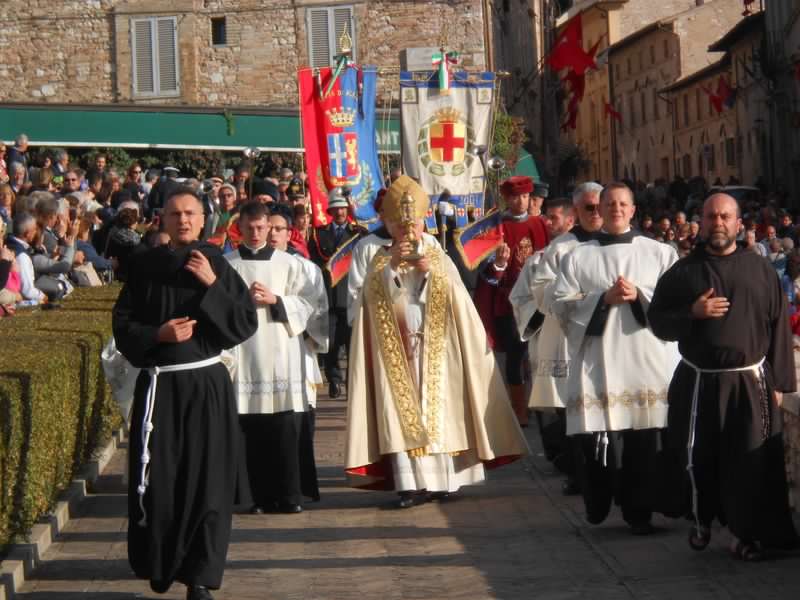
Feast Day Pageant in Assisi, Italy, October 2015.
The first time I visited Assisi, Italy – St. Francis’ hometown – was back in 2015. My mom and I had taken the first of our six European trips the year before. Wanting to return to Italy again, I researched whether any festivities would be held in Assisi on October 4th. Much to my delight, I discovered that an annual religious pageant would be held to honor the saint. What better way to celebrate my birthday than with an Italian festival, I thought. And so we did! Between viewing the monumental cathedrals, basking in the beautiful Umbrian countryside, and watching what seemed like the whole country celebrating my favorite saint on my birthday, I didn’t think anything could be any better. Much to my delight, it could and did.
A statue of St. Francis in knightly garb on horseback graces the church lawn outside the Basilica de San Francesco in Assisi, Italy. The sculpture expertly captures Francis’ dejected spirit after returning home following the Perugian war.
Flash forward to eight years later, in October 2023, when I was privileged to return to Assisi – this time with my new husband. This time, I wasn’t just revisiting the place that brought me such fond memories years before. This time, I was visiting Assisi to celebrate not just the Feast Day of St. Francis on my birthday but also to partake in my honeymoon with my soulmate. I felt doubly blessed to share the beauty of Italy with my spouse, along with the spirit of this patron saint who always touched my soul.
Born in the hill town of Assisi, Italy, in 1181, Francis’ father was a wealthy fabric merchant. Initially christened as Giovanni di Pietro di Bernardone, the renowned saint didn’t keep his given name long as his father preferred the name Francesco or Francis as he’s more commonly referred to outside Italy.
As their only son, his parents indulged Francis from birth – and it showed. Francis was always popular amongst his peers due to his love of boisterous living, reckless spending, and charismatic nature. In his early twenties, Francis found himself caught up in the perceived glamour of war and joined his friends to wage battle against the neighboring city of Perugia.
Unfortunately for Francis, the battle didn’t end well. He was captured by the opposition and held for ransom for almost a year. Shortly after his release from imprisonment, Francis became extremely ill with malaria – a disease that plagued the saint his entire life and likely contributed to his death.
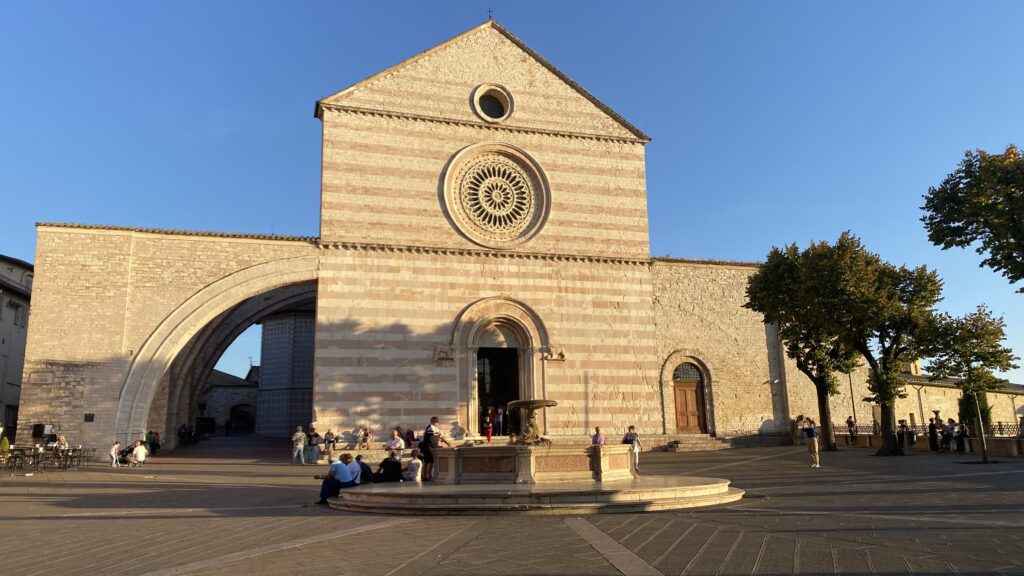
The Basilica de Santa Clara sits on the south end of Assisi, Italy. Clare (Clara in Italian) followed Francis’ example and established her own sect of nuns who, like Francis’ monks, also lived in self-imposed poverty while helping the impoverished in their community. Read more about Clare and her Order of Poor Ladiesby visiting https://www.biography.com/religious-figures/saint-clare-of-assisi.
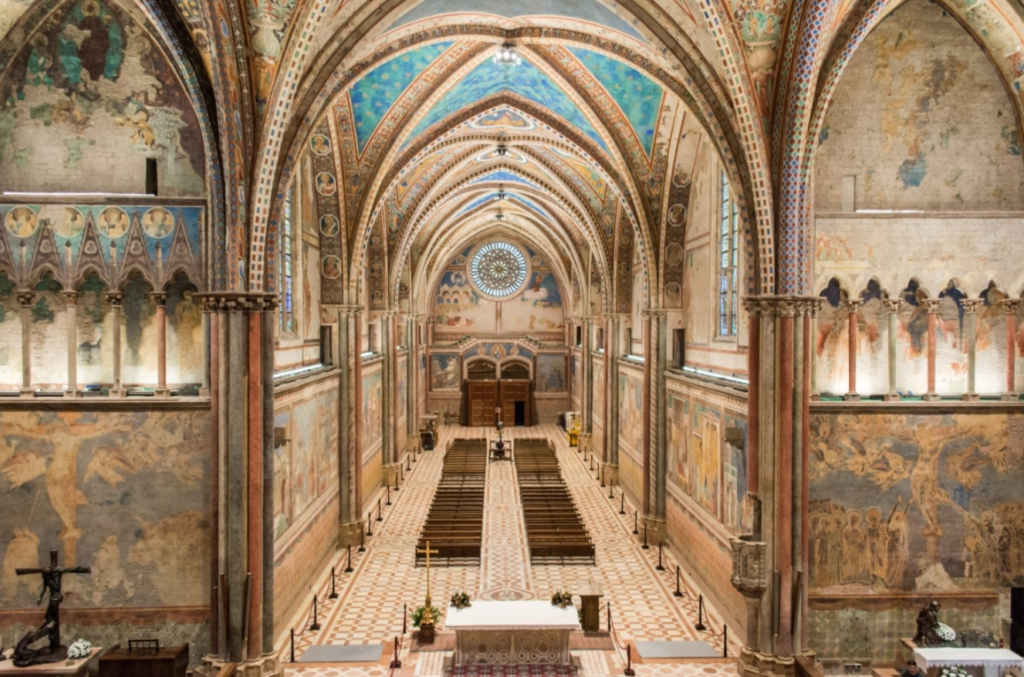
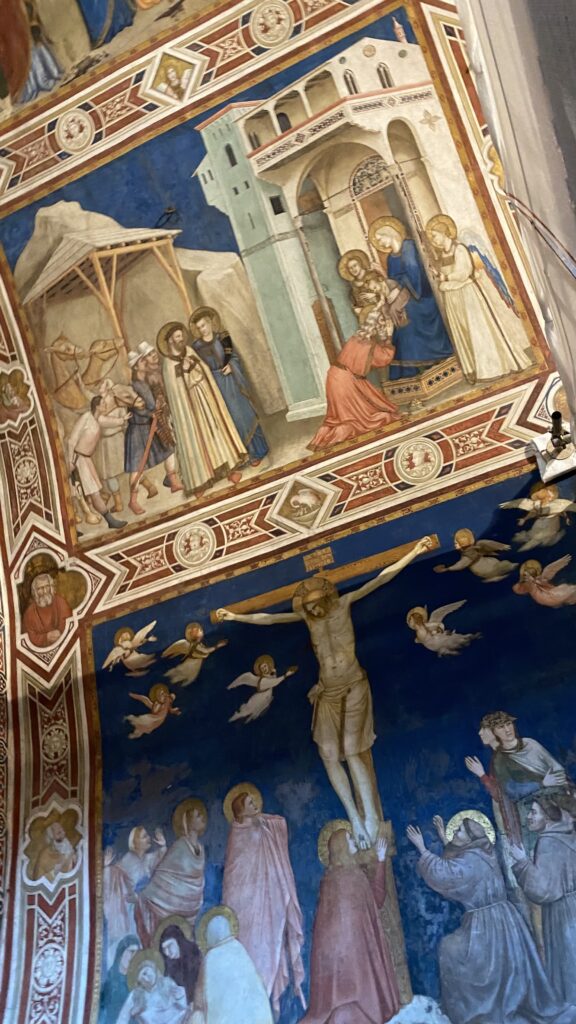
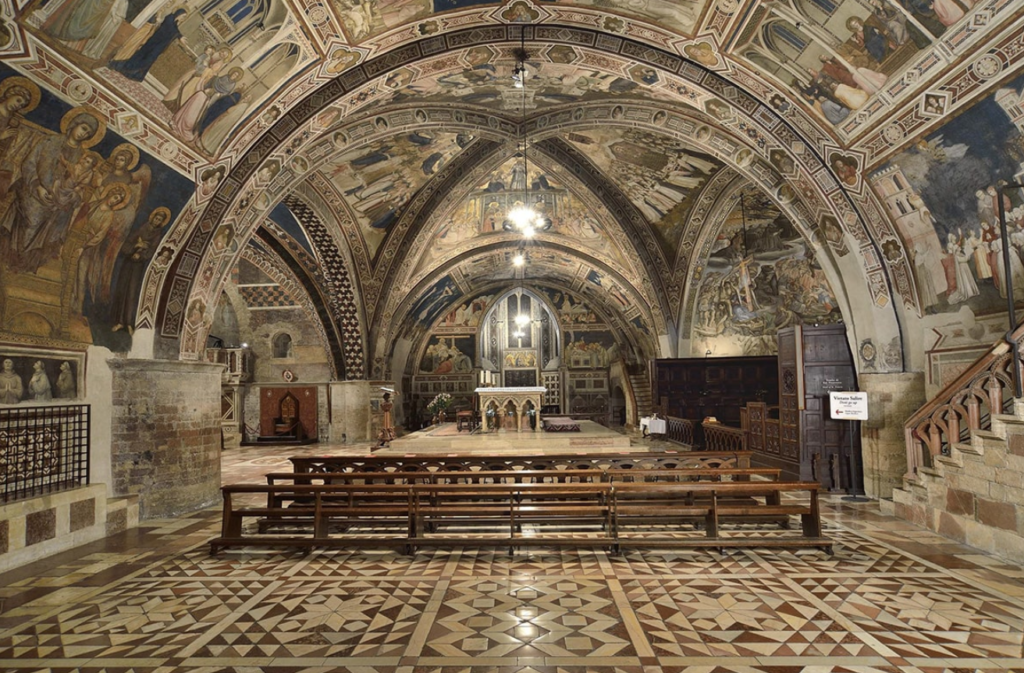
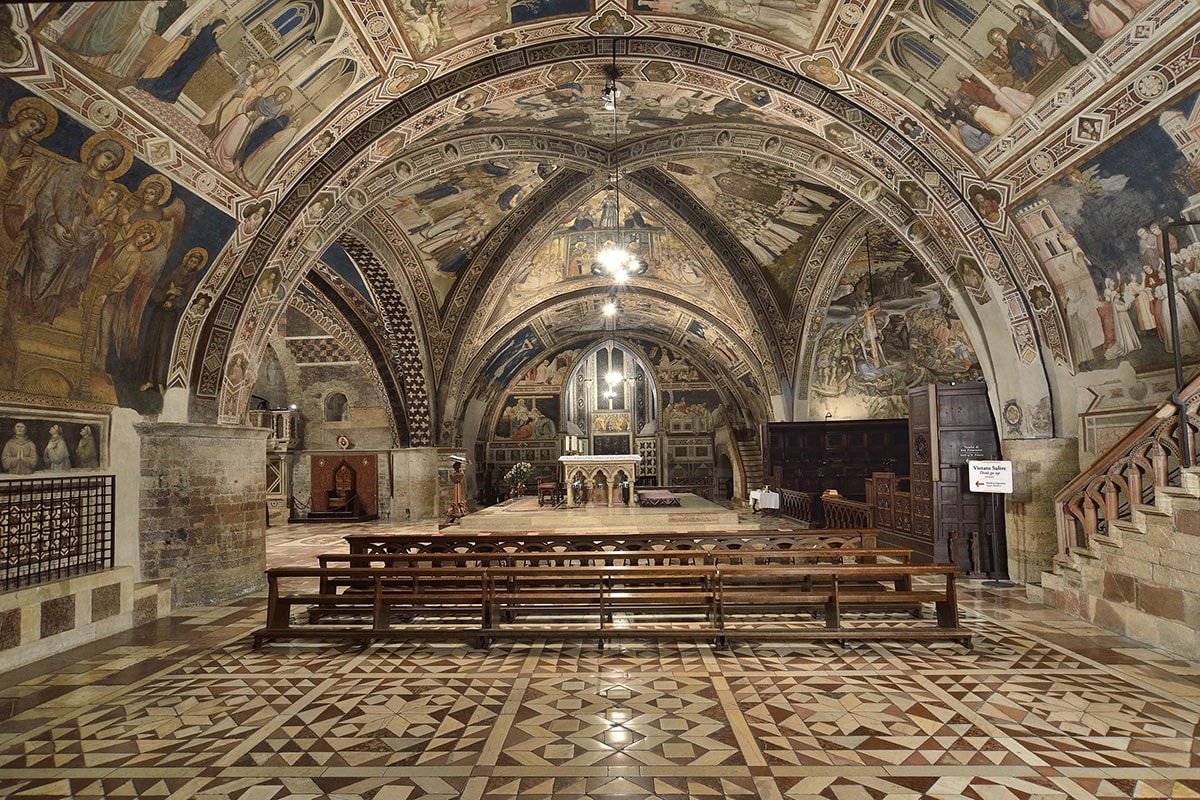
The above photo shows one of the medieval frescoes in the Basilica Inferiore of St. Francis. The scenes depict Biblical and medieval stories. Many of these artistic creations – painted in the 13th and 14th Centuries by the likes of Simone Martini, Pietro Lorenzetti, Cimabue, Pietro Cavallini, and (possibly) Giotto – were painstakingly cleaned and restored following a spate of earthquakes (23 in total) that shook the region, the most recent occurring in 1997. The colors and clarity are as beautiful today as when they were initially painted.
Undaunted by his travails, Francis celebrated his recovery by accompanying a fellow knight to another battle – this time against the Germans. At the onset of his journey, Francis encountered an impoverished man and was deeply moved by the traveler’s poverty. Compelled to help, Francis compulsively changed clothes with the stranger – trading his wealthy apparel for rags. Upon returning to his quest, Francis suffered a relapse of malaria that debilitated him, yet again. During this bout of infirmity, Francis heard God tell him “to serve the Master rather than the man,” – a calling he later adopted wholeheartedly.
Disillusioned by his former lifestyle, Francis began a new quest – this one of a spiritual nature. Hoping to discover his life’s purpose, Francis would often wander the countryside for extended intervals. It was during one of these walks that Francis encountered his first leper. Initially shocked by the man’s appearance, Francis’ reaction quickly transformed from revulsion to compassion. Without thought for himself, Francis grabbed the leper’s hands to kiss them, ultimately giving all the money in his possession to this less fortunate soul.
This encounter inevitably became a turning point in Francis’ life. From that day forward, he began seeking out the poor – both near and afar. On one such occasion, he enthusiastically gave all his clothing to a group of beggars while visiting Rome. There, Francis learned the humility of having to beg for the mercy of strangers as he stood amongst the impoverished with outstretched hands.
Returning home, the well-intentioned Francis packed his father’s horse with a bundle of fabric – ultimately selling the goods and the horse in the nearby town of Foligno. Although Francis attempted to give the proceeds of this sale to the priest of a nearby, broken-down church known as San Damiano, the priest refused to accept the money – hesitant to receive benefit from ill-gotten gains. A somewhat disillusioned Francis then offered his services instead.
His labor being acceptable, Francis soon began assisting the priest in the much-needed restoration of San Damiano. All seemed good until his father came looking for him. Frightened by his father’s wrath, Francis hid for a month before returning home to beg forgiveness.
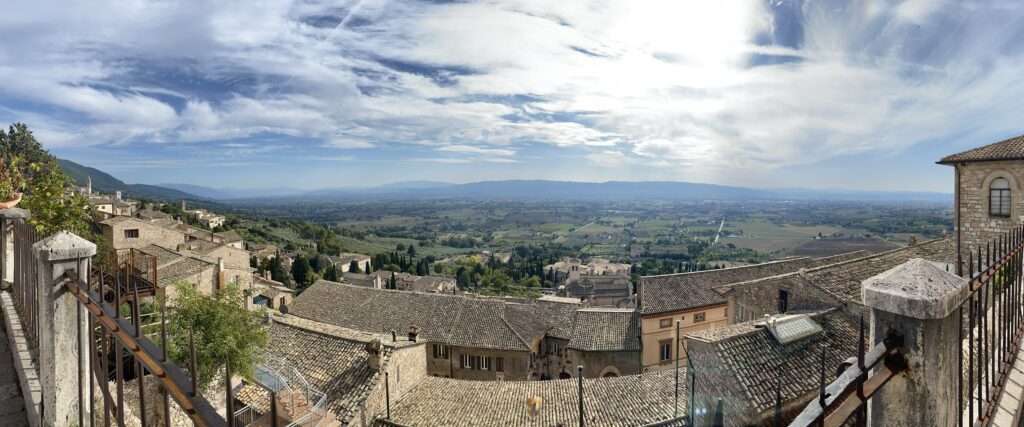
View of the Spoleto Valley from the wall surrounding the city of Assisi.
Unmoved by his son’s appeals, Peter beat Francis mercilessly – fettering his ankles and eventually hauling him to the church to stand trial for his theft. Overcome with remorse, Francis returned the money he had stolen from his father, along with all the clothes he was wearing at the time.
Standing naked before the priest, Francis made a life-shattering announcement. “Hither to I have called Peter Bernadone father,” Francis proclaimed. “From now on I say only, ‘Our Father, who art in Heaven.'”
In shock, the bishop covered Francis’ naked body with his own cloak until a gardening smock could be provided. Rather than shame, this simple act of surrender filled Francis with great joy. After this incident, he spent months roaming the countryside, praising God, and working for his daily provisions. Months later, a childhood friend took pity on him and provided Francis with food, clothing, and shelter.
Unsatisfied by his contrition, Francis inevitably returned to San Damiano to help again – this time seeing the restoration work through until completion. Upon concluding his work at San Damiano, Francis took notice of an even more dilapidated chapel, St. Mary of the Portiuncula, which stood in ruins just a few miles from Assisi. Owned by a Benedictine monastery, this ramshackle chapel ultimately became Francis’ next project. Determined to restore the church ruins to their former state, Francis’ labors soon became known throughout the region. His successful restoration work might have led him to spend the rest of his days as a hermit had God not pursued this humble servant for an even greater calling.
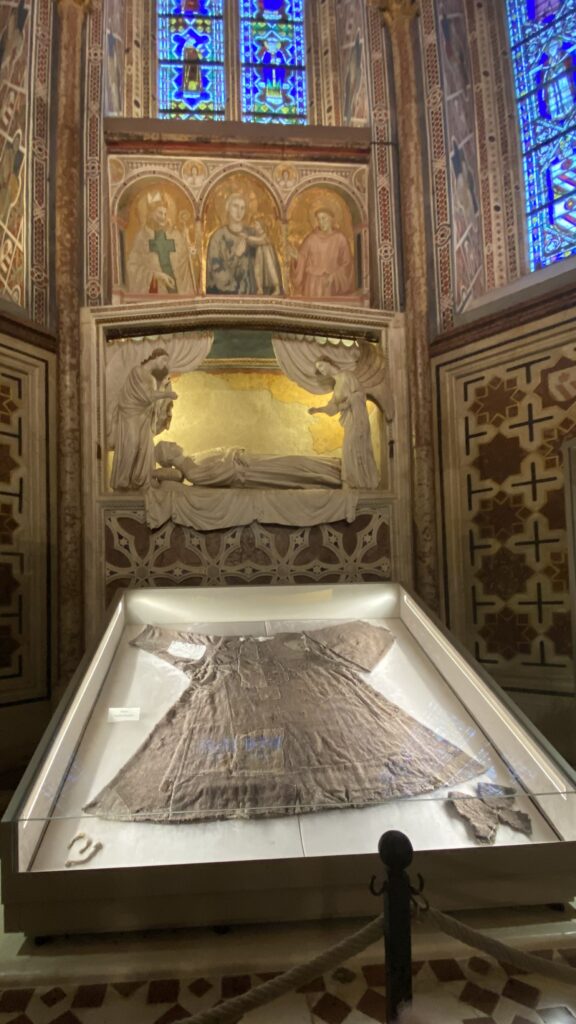
A ceremonial casket adorning the wall of the St. Nicola Chapel in the Basilica Inferiore is visible behind an encased burlap cloak, socks, and rope worn by St. Francis. Francis’ grave remained undiscovered until 1818, following an excavation of the church’s lower level commissioned by Pope Pius VII. Francis’ remains were later interred inside a stone pillar below the church in the Cripta di San Francesco. The space features a chapel for visitors to light candles and pay respect to the beloved saint.
While restoring this decrepit church, Francis came across a passage of scripture that compelled him to take further action. Matthew 10: 8-10 guided Francis with these simple words: “Freely you received, freely give. Do not acquire gold, or silver, or copper for your money belts, or a bag for your journey, or even two coats, or sandals, or a staff; for the worker is worthy of his support.”
Receiving an epiphany from God, Francis cast off the last of his worldly goods – his cloak, shoes, and leather girdle – keeping only his rough outer tunic, which he tied to his waist with a rope. Francis’ simple ways, uplifting spirit, and joyous acceptance of poverty and charity soon earned him a following. It wasn’t long before other believers joined Francis by taking up the mantle of poverty and service alongside him. For the next year, he and his fellow companions began preaching to the poor, helping farmers in their fields, and living as beggars by whatever means were provided to them.
Seeking affirmation regarding his new lifestyle, Francis felt compelled to learn whether his notion of simple service to God through self-imposed poverty might be an acceptable way to live and guide others. Francis and his fellow companions traveled to Rome, hoping to receive the Pope’s counsel. Francis was only 28 when he undertook this journey of roughly 342 miles on foot – with no provisions for the pilgrimage.
David and I secured a great spot along the wall near the Basilica of St. Francis to better view the Feast Day pageant.
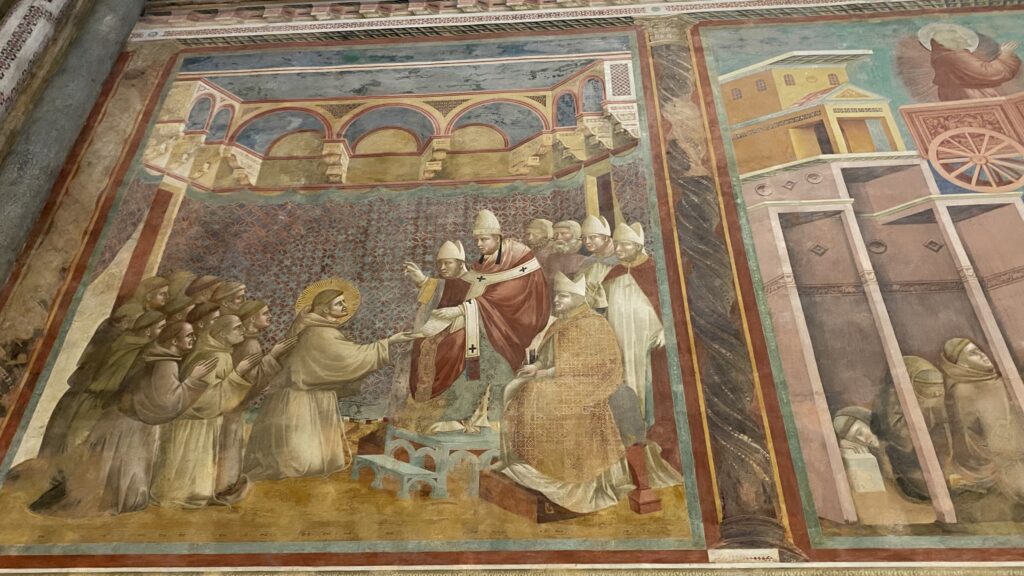
Granted an audience with Pope Innocent III, Francis received approval to further his mission. Ecstatic at this newfound validation, Francis and his companions joyously returned to Assisi, where he was later gifted with the beloved chapel he had restored in Portiuncula along with the adjoining grounds – in perpetuity. Affirmed and invigorated, Francis soon began the consecration of his fellow friars in what would eventually become known as the order of the Franciscan Friars. This ordination continues its charitable work and pious living to this day.
This fresco depicting St. Francis and his fellow monks visiting Pope Innocent III adorns one of the walls of the Basilica Superioreor Upper Basilica of San Francesco.
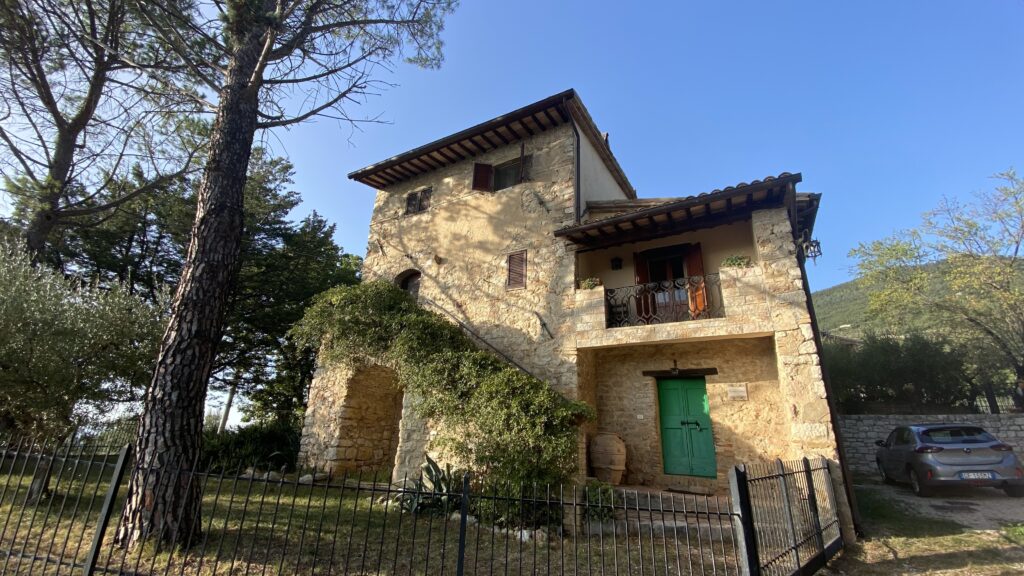
Beautiful, three-storied, medieval tower home where David and I stayed during our four-night stay on the outskirts of Assisi, Italy.
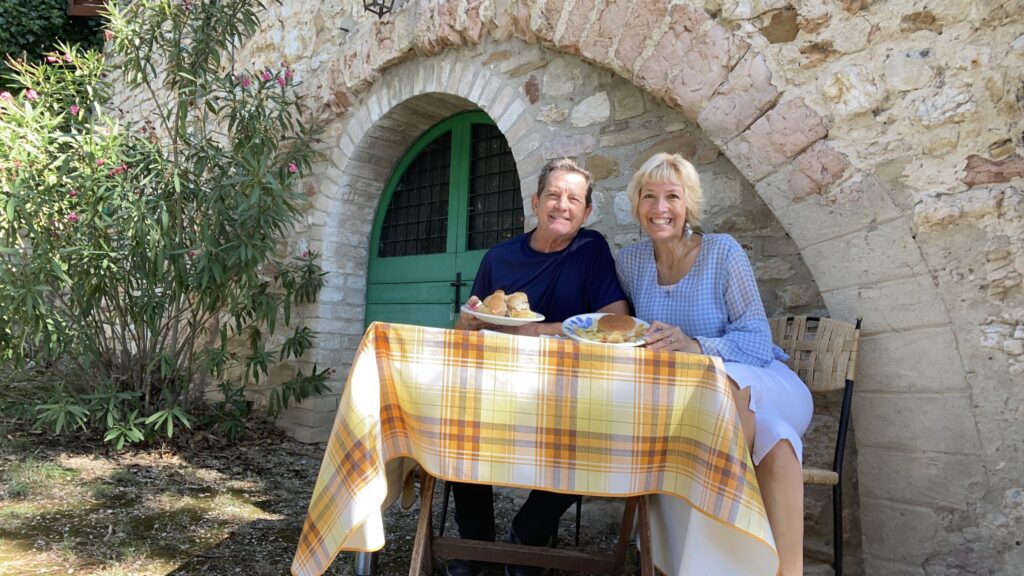
This brings me back to David’s and my October 2023 visit to Assisi. For our five-night stay, we were privileged to overnight in a three-storied, medieval tower home dating back to 1500. The house was likely a watchtower with a stable or tavern on the lower level. Surrounded by olive groves, our view of the Spoleto valley was stunning – only eclipsed by the view from the hill town of Assisi itself. Each day we were there, David and I pulled a tavern table out to sit in the small yard and create our own sidewalk café overlooking the valley.
David and I enjoyed dining al fresco on the little table we pulled out from the tavern below our Assisi vacation home. While the sloping hill made the tabletop uneven, we still felt incredibly blessed to eat at our own little sidewalk cafe in the Umbrian countryside.
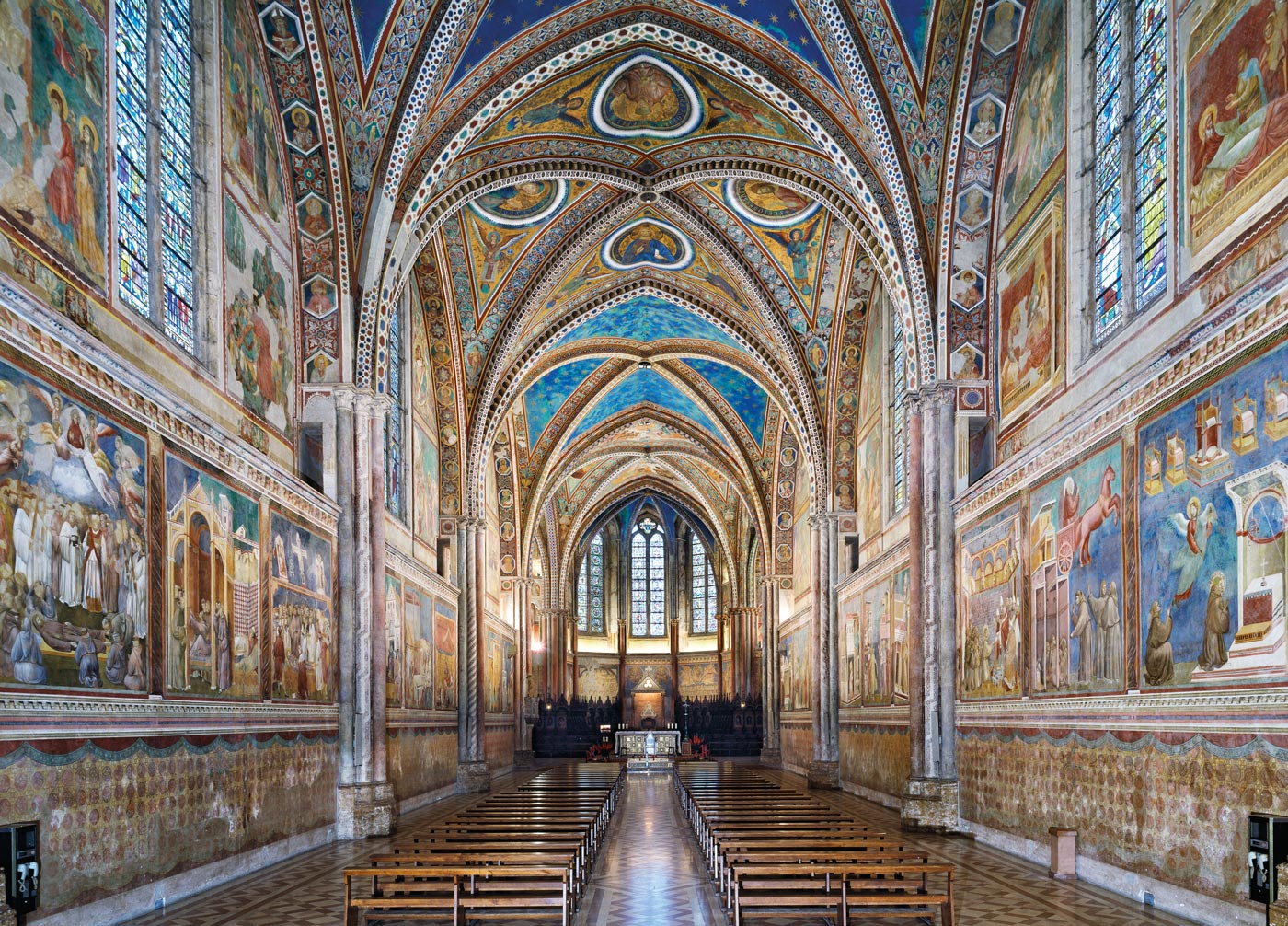
In Assisi, we visited the two-storied Basilica of Santa Clara at the southern end of town and the three-storied Basilica of San Francesco – book-ended at the north. The medieval frescoes covering the Franciscan Basilica walls were stunning unto themselves. Still, David and I were unequivocally blessed not just to see the church but also to attend a free operatic concert in the lower sanctuary.
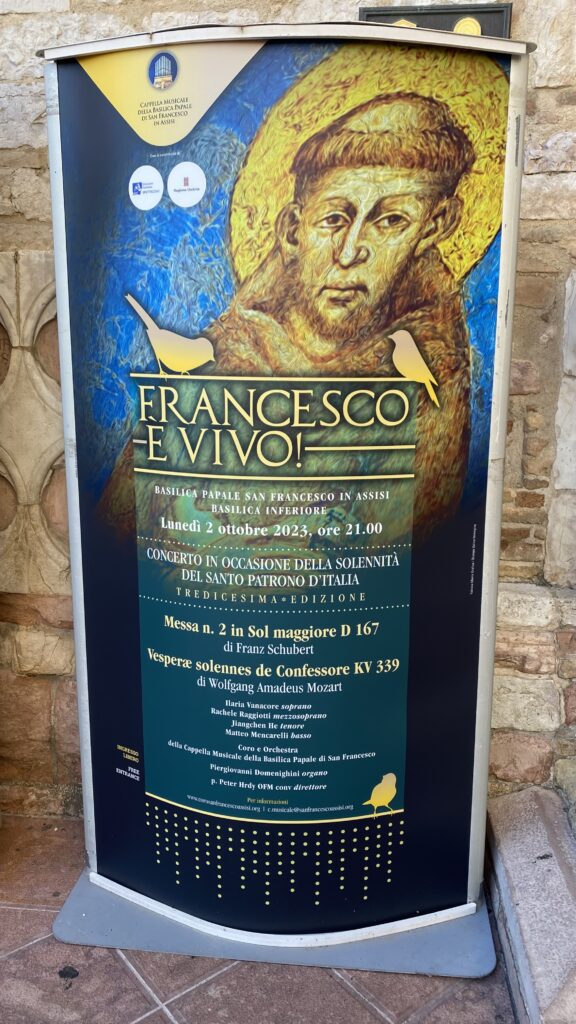
Hearing Mozart and Schubert while surrounded by the unparalleled, centuries-old artistry in this holy cathedral stirred my heart and soul in a way I’ll never forget. At the stroke of the first chord that resonated in sheer perfection throughout the space’s acoustics, both David and I were brought to shed tears of wonder and gratitude at God’s indescribable gift. We had no previous notion about the concert – having only chanced upon an advertising poster, in Italian, outside the lower sanctuary while touring the historic church that same afternoon. What were the odds of us being there at the right time and place? Our discovery could only have occurred by the hand of God, and we knew it.
This poster advertised the operatic concert that David and I attended in Assisi. If we’d not toured the church that day, we’d never have seen this poster nor been aware of the free performance that same evening.
Days later, on my birthday, David and I arrived early in Assisi to wait for the afternoon’s procession to begin. Having witnessed the pageant eight years prior, I knew what to expect and chose a great spot near the wall that overlooked the street where the procession would begin from the lower level, out through the street, and up to the front of the basilica. Franciscan monks from every walk of life were accompanied by countless nuns from around the world who’d traveled to the city for this annual event.
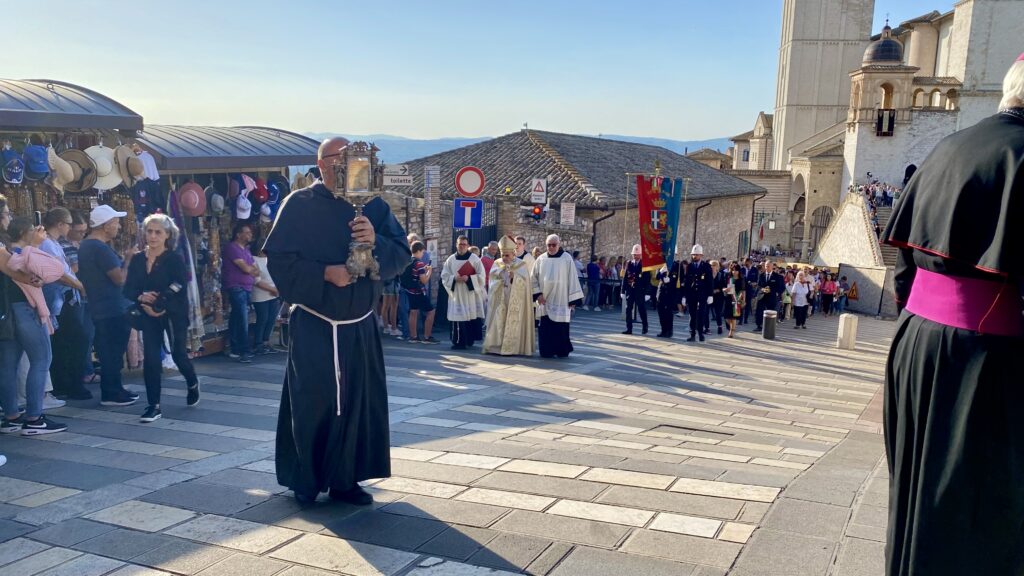
The pageant is led by clergymen carrying crosses and an ancient Franciscan relic of some sort. This year’s relic – permanently encased in glass and mounted on a brass staff – appeared to be a small, written parchment – presumably from the quill of St. Francis himself.
A cantor standing on a rooftop tower led the procession in a responsorial request for forgiveness. While we couldn’t grasp all the Italian words spoken, we understood that the cantor was beseeching various saints for forgiveness. At each pause, those olive branch-carrying processiongoers responded with repeated, sing-song intonations of “Prega perdone,” meaning “Pray for forgiveness.” Slowly and steadily, the line curved around from the lower sanctuary, along the street, then turned onto the front lawn, continuing to the front doors.
As seen above, a monk carried a glass and brass-enclosed Franciscan relic in the 2023 pageant on the Feast Day of St. Francis. The relic appeared to be a written page scripted by St. Francis himself.
On an impulse, I grabbed David’s arm and told him I wanted to join in. “Let’s go,” I said as we moved with the crowd. We stopped with the procession in front of the church and listened patiently as the bishop provided a brief homily in Italian from the rooftop balcony. Afterward, the basilica’s doors opened, and we again joined the crowd to move inside the upper sanctuary.
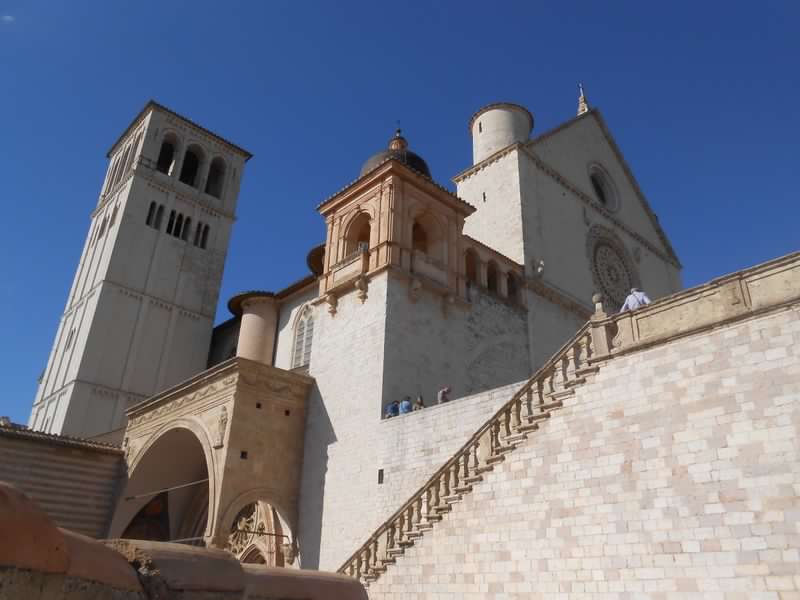
The tower in the middle of this photo is where the Bishop and cantor spoke and sang during the Feast Day of St. Francis pageant in Assisi, Italy.
Only then did I realize the service was continuing with a choir accompanying the chords played by a magnificent pipe organ. Seeing others filming inside the space, I quickly did the same with my phone, capturing everything I could in the room where photographing usually is not allowed.
Although David and I couldn’t understand what was spoken or sung, we knew we were surrounded by fellow believers in a sacred space. I was so grateful to my Creator for not only finally being able to capture a bit of the centuries-old frescoes telling the life of St. Francis that adorned the sanctuary walls but also to worship my Creator in this place with my God-given husband.
The joy that accompanied this entire visit – from our walks through the town, our attendance at an unplanned, soul-stirring concert in the basilica, our spontaneous pageant accompaniment, and the magnificent blessing of being able to attend part of a service in this grand cathedral were all nothing short of a tremendous gift from God.
While I’m not quite prepared to surrender all my worldly goods to live as Francis did, I can still embrace and amplify his mindset. As Micah 6: 8 reminds us, “And what does the Lord require of you? To act justly and to love mercy and to walk humbly with your God.”
May I never cease to do so – not just while walking the steps that St. Francis walked in Assisi, but every single day of my life.